Domestic Chaos Deep Dive
Timers: A Short History of Tiny Tyrants That Make Projects Finishable
Deep-dive: an illustrated, readable history of mechanical and visual timers, Pomodoro culture, and how different timers change hobby behaviour. Includes key facts, a three-panel timer chooser and two supporting illustrations.
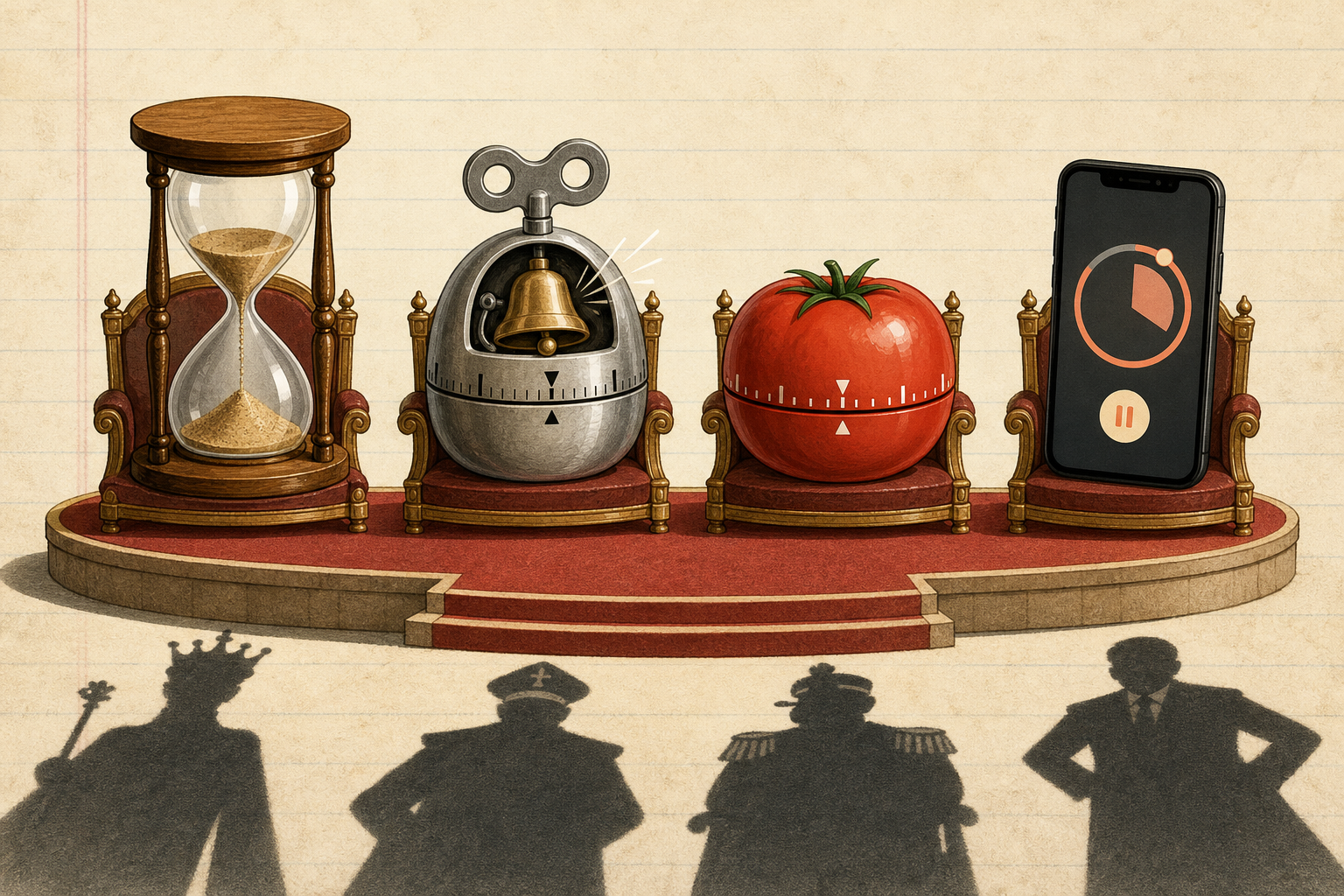
Why tiny tyrants are the most effective managers you'll ever hire
A timer is a promise you make to yourself and then immediately outsource to a contraption that refuses negotiation. The charm of a timer is not mystical; it is practical: it turns vague intentions—"I'll work a little"—into a finite, non-negotiable interval. That hard boundary converts the impossible task of "finish someday" into "finish this stretch now."
Think of a timer as a miniature autocrat who enforces a single rule: work or stop until the bell. The psychological power comes from limiting choice and reframing effort as episodic. Breaking a project into court-mandated sessions makes attention rentable: you can buy thirty-minute blocks of focus and, crucially, get them back when the session ends. Set the clock and you have a defensible excuse to start—and to stop.
Gears, sand and the sound of ticking: how physical timers actually work
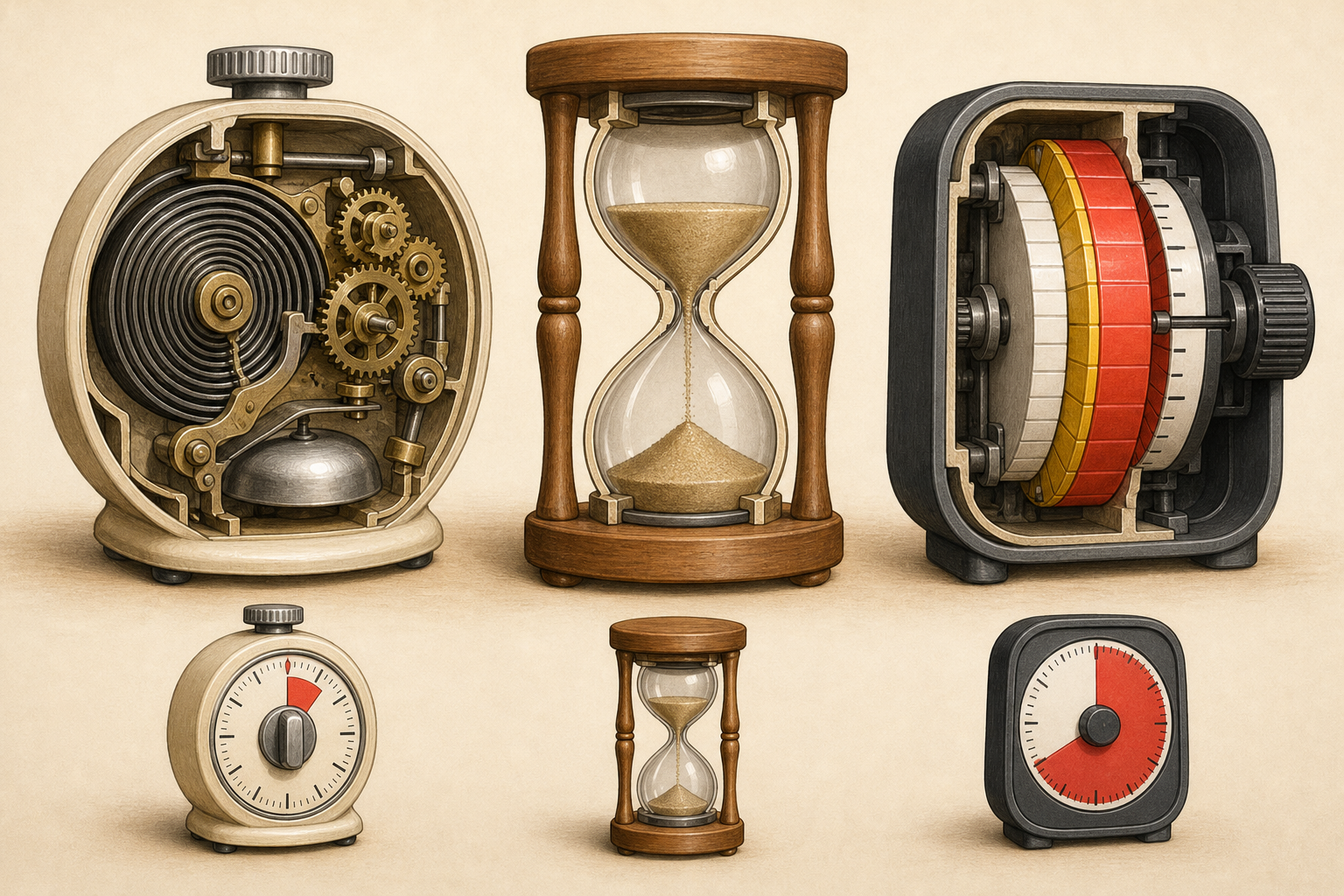
Mechanical timers are kinetic choreography. A wound spring, teeth on a gear train and a governor or escapement convert stored tension into a predictable sequence of motions that culminate in a bell or buzzer. The user provides the initial energy by twisting; the mechanism decides when that energy has been used up. This creates a satisfying feedback loop: you wind it, it runs, and then it pings.
Hourglasses and sand timers are the dead-simple cousins: the only precision is gravity and the aperture between chambers. Visual timers that change color or reveal segments use simple optics and gravity or a clock movement to make time visible without noise. Each mechanical choice—tick versus silence, visual promise versus audible demand—nudges behaviour in different directions. Wind it, watch it, be told when is the basic contract.
The Pomodoro and its relatives: ritualized intervals and culture
The Pomodoro Technique, named for a tomato-shaped kitchen timer, formalized the idea that work in fixed intervals with short breaks makes attention renewable. The original prescription—short sprints followed by rests—became easily memetic because it gave people a simple ritual to follow. Over time that ritual has sprouted variants: long-sprint adaptations for deep creative work, ultrashort sprints for anxious starts, and group Pomodoros where a shared bell marks mutual accountability.
Digital tools and dedicated hardware both amplified the technique. Apps add analytics, visual timers add calm, and physical timers add ceremony; each communicates a slightly different flavor of discipline. The ritual element matters: when a timer is also an object you handle—a tomato, a metal dial, a chunky sandglass—you get a micro-ceremony that frames the session as something worth defending. Start with a ritual and the session becomes a tiny event.
How different timers change hobby behaviour: a three-panel chooser
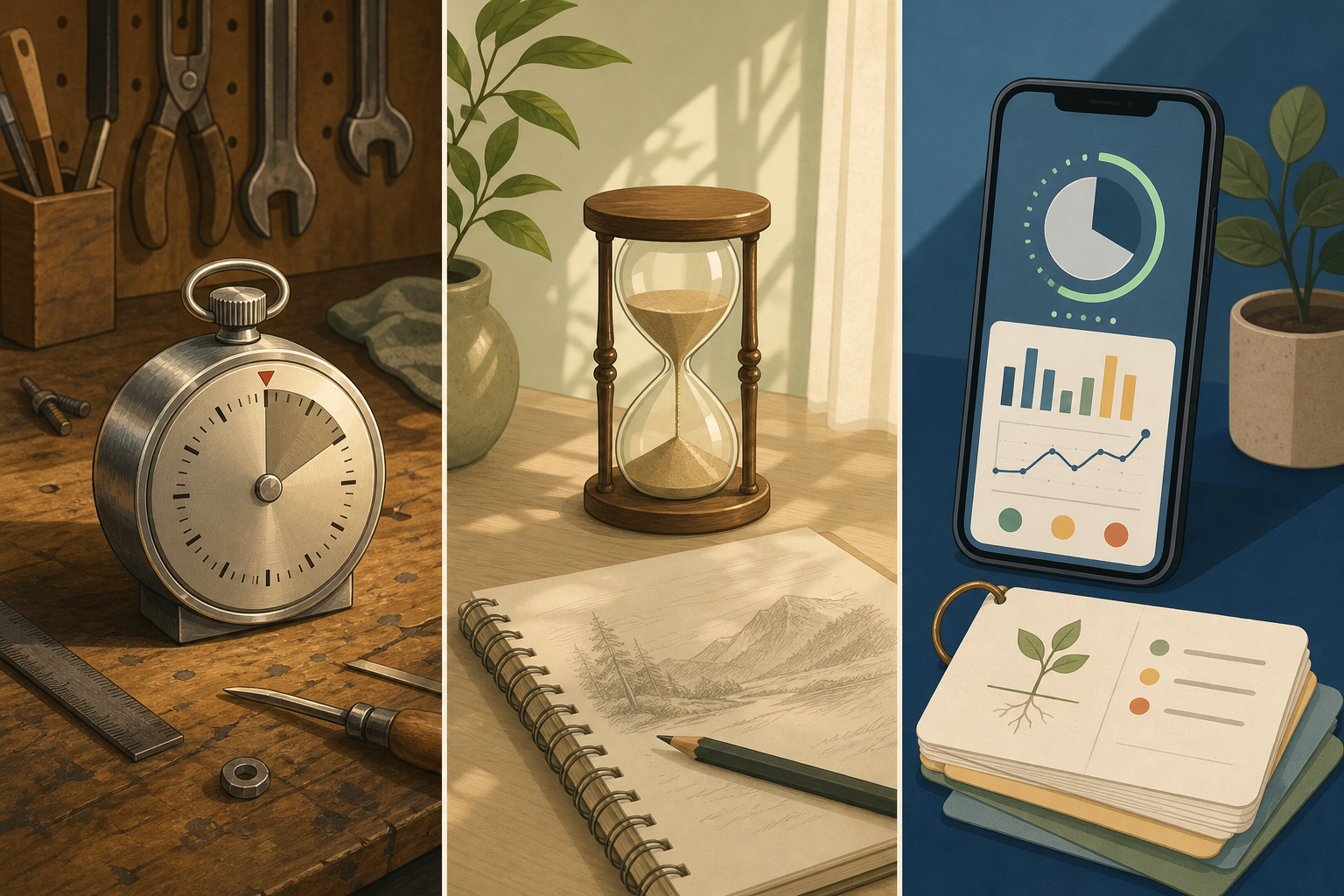
Timers do more than measure time; they shape how you approach a hobby. A relentless ticking kitchen timer promotes momentum and can increase speed at the cost of delicacy—excellent for chores and mediocre for careful model painting. A silent visual timer reduces stress and supports tasks that demand steady hands or reflective mood, like journaling or drawing. Digital countdowns with statistics breed optimisation: they make practice measurable and competitive, which is superb for skill drills but can turn leisurely activities into metrics-driven loops.
Imagine three panels you can pick between: a wind-up metal timer (speed and momentum), an hourglass or visual segment timer (calm and continuity), and a smartphone timer with data (discipline and feedback). Each one is a different tiny dictator: one yells, one nods gravely, one hands you a spreadsheet. Choosing your tyrant is a behavioural act—pick the right boss for the job—and the wrong one will make a relaxing hobby feel like a sprint and a focused drill feel like a chore.
Assembling a finishing ritual and a dramatic final word
A timer is most useful when embedded in a ritual you respect. Consider a three-step micro-ceremony: prepare (clear one small workspace), declare (set the timer and say the intended task out loud), and honor (when the bell rings, record one sentence about progress). These minimal rites convert the timer from a mechanical interrupter into a social artifact that reminds you of purpose and completion.
Tiny tyrants are humble servants that demand attention in exchange for structure. Embrace the absurdity: pick a ridiculous object to be your timer if that absurdity helps you start. The point is not perfection; it is finishability. Let your tiny dictator ring, step away, and then, when ready, wind another term of office. Keep the bell ringing—your projects will notice.
End of the rabbit hole.
You know too much now.
If this was useful
Try one of these next

Domestic Chaos How-to
How to stage a monthly Return-to-Focus Tea Ceremony for two fragile attention spans
A five-step theatrical reset—tea, bell, shared 10-minute list, gazing vow, tidy corner—that turns refocusing into a miniature celebration. Payoff: gentler transitions and a weirdly soothing habit.
Read article
Domestic Chaos Deep Dive
The fidget’s manifesto: how tiny objects staged a coup in boardrooms and living rooms
An illustrated history of fidgets as behavioral theatre: why certain textures soothe, the etiquette of silent spinning, and how to assemble a household fidget cabinet that converts anxiety into plausible productivity.
Read article
Domestic Chaos Deep Dive
The calendar altar: worship, sacrifice and sticker diplomacy for ADHD timekeepers
Investigates planners as miniature temples—color rites, buffer-zone sacrifices, alarm liturgies and sticker economies—showing how to turn a calendar into a forgiving deity that forgives missed starts.
Read article
Making & Mischief Listicle
9 Micro-Hobbies You Can Finish in the Time It Takes to Microwave a Potato
Nine gloriously unnecessary micro-projects you can start and finish in the minutes it takes to microwave a potato. Ranked from politely pointless to epically ceremonial (our totally subjective metric: the combination of theatricality, ridiculousness, and the chance you’ll actually brag about it). Each entry lists exact materials, a strict timer, and a single glorious finish move so you get a full achievement without commitment.
Read article