Social Survival Deep Dive
The exit: an unauthorised biography of leaving rooms, parties and conversations with zero collateral
An anatomy of departures—sighting lanes, decoy conversations, timed goodbyes and the ceremonial handshake—so you can evacuate public spaces with dignity (and an escape route mapped to your brain’s attention span).
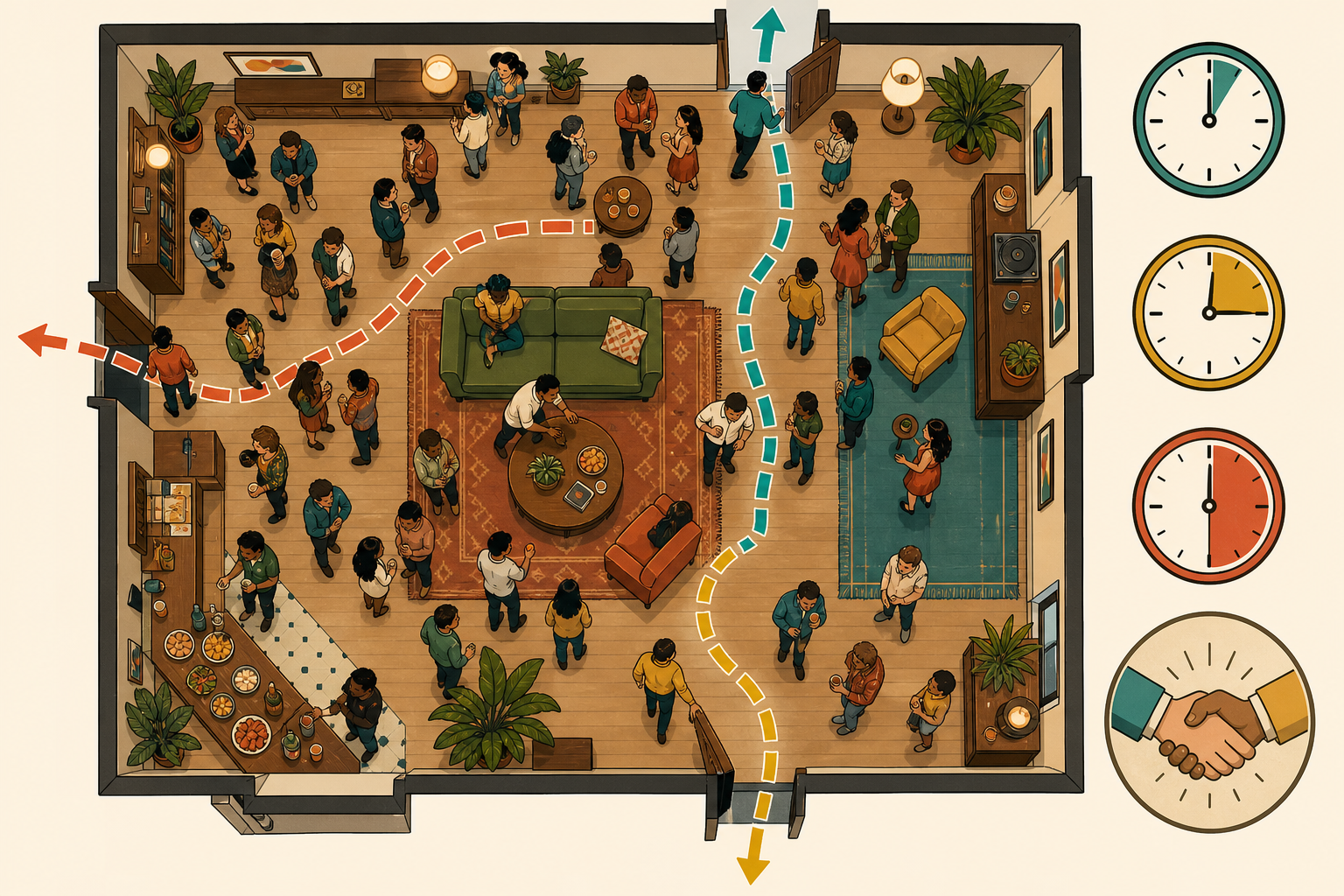
Departure as a ritual (and also a practical skill)
Exiting a room is rarely just a physical motion; it’s an unscored performative act where intentions, furniture and peripheral attention conspire to either let you slip away or reenroll you into the conversation. Treating the exit like an afterthought is why most departures produce collateral: a sustained eye-lock, a delayed question, an awkwardly extended hug.
If you accept exits as rituals, you can formalize small gestures and spatial habits into reliable moves. Plan a sightline—even a mental one—before you need it, and the remainder of the choreography becomes less improvisation than practiced shorthand.
This piece studies exits as both geometry and etiquette: where people stand, how conversations cluster, how attention drifts, and which micro-actions consistently reduce friction. Nobody discovered this in a lab; these are sober observations about ordinary social mechanics, given the ceremonial pomp they deserve.
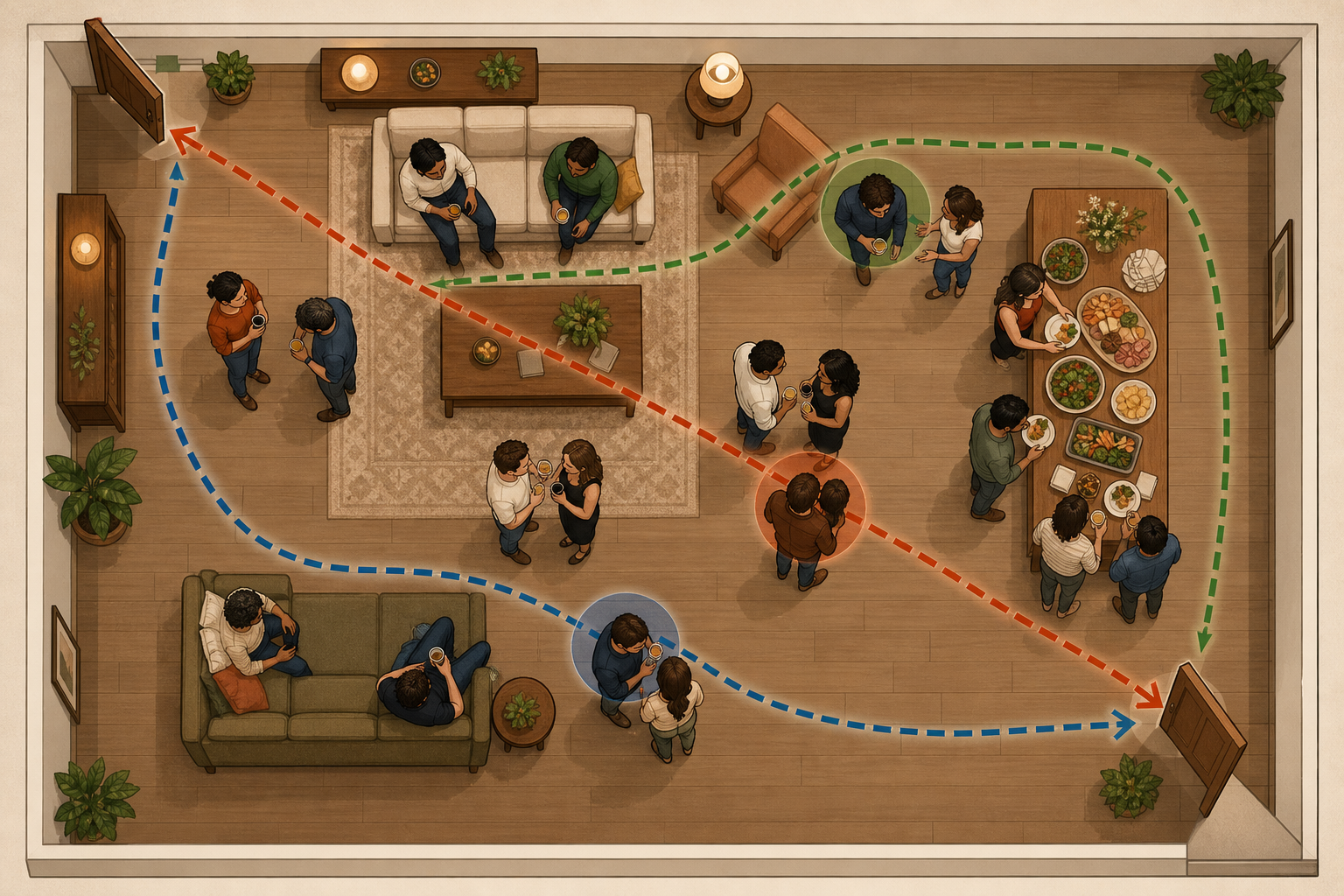
Sighting lanes and the room’s secret architecture
Rooms have lines of sight the way cities have alleys. A sighting lane is the unobstructed corridor between your current position and an exit where you can move without being pulled aside mid-route. Furniture, food tables and the way groups orient themselves create choke points that will make a simple walk to the door feel like a diplomatic tour.
Map the room quickly: identify two exits, one primary and one contingency, and trace the lane that bisects the fewest clusters. The single most underrated talent at a party is the ability to walk with purpose along a lane, because purposeful motion resists interception.
Choose a lane early and keep note of it; the mental act of selecting a route lowers the chance that someone will redirect you before you clear the doorway.
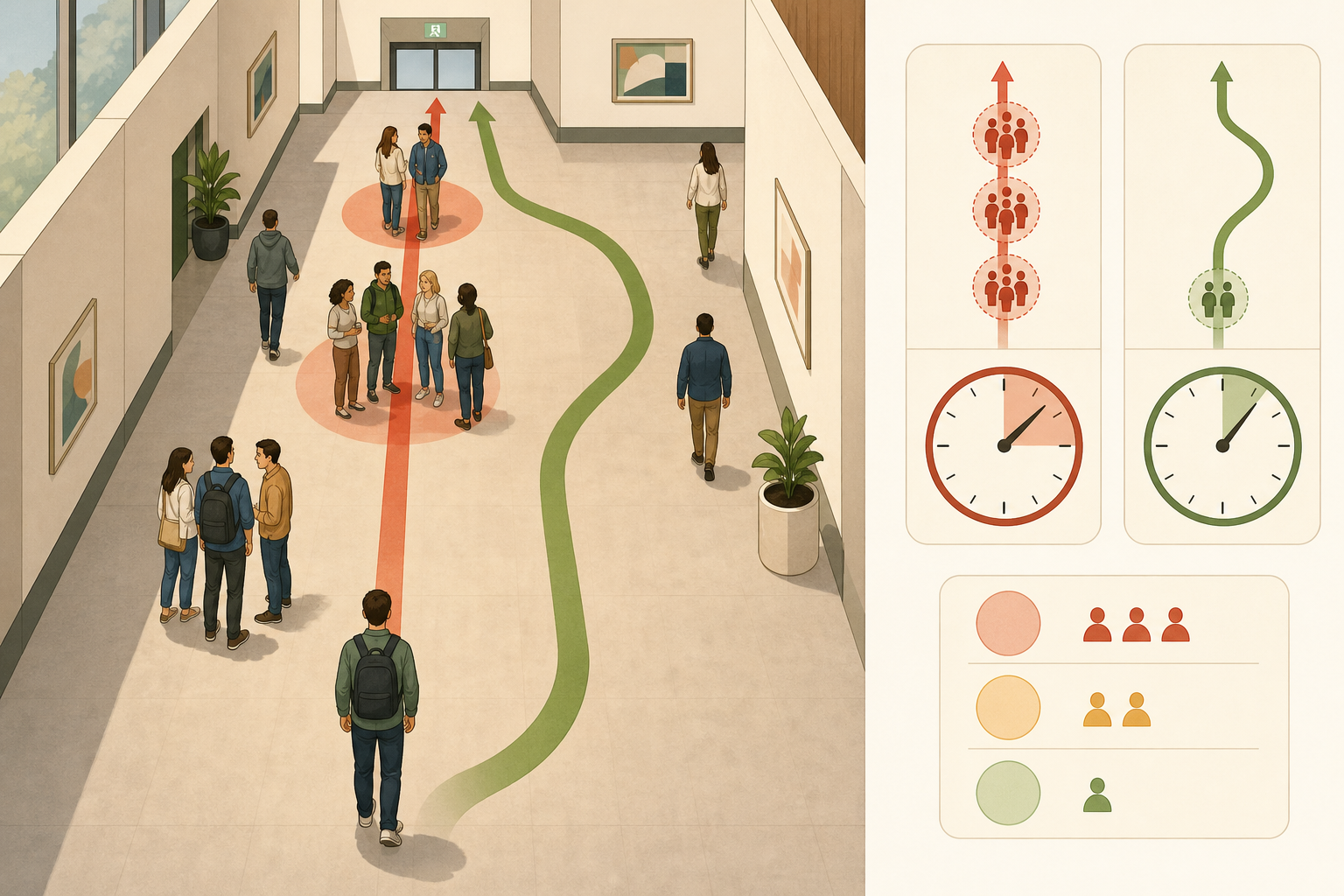
Decoys and conversational engineering
Conversations can be coaxed like reluctant houseplants. Introduce a decoy fact, an off-ramp topic or a third-party mention that naturally drifts toward closure. A mild compliment that wraps up a speaker’s thread, or a logistical prompt (“Oh, before I forget your email”), functions as a social period: it signals conclusion without sounding brusque.
The old “I should say hi to the host” gambit is serviceable, but decoys scale better: they let the group complete the thought while you stage your retreat. Likewise, allowing someone else’s phone to ring can be morally gray but extremely effective as an interruption that creates a breathing space.
Offer a summarizing compliment or a logistical hook and step back; it reads like appreciation, not abandonment, and it gives you a socially acceptable gap to leave.
Timing exits to attention spans — the three-minute rule
Human attention in casual conversation tends to oscillate predictably: an initial spark, a plateau, and a decay where interest moves elsewhere. Practically speaking, if you can keep an exchange under three minutes at a single conversational node, you often avoid becoming the topic’s anchor.
This is not a scientific law—attention varies wildly with chemistry, context and who is telling the story—but treating three minutes as a default threshold helps you know when to cut your losses and step away, or when to invest more time if the interaction is unusually rewarding.
Use the three-minute mental timer as a heuristic: if you’re approaching it and the interaction hasn’t produced a natural pause, introduce a decoy or a closing line to reallocate attention without drama.
Ceremonial exits: handshakes, micro-speeches and the goodbye economy
There’s a surprisingly large taxonomy of goodbyes: the handshake (brief, formal), the hug (warm but ambiguous in length), the wave (public and efficient), and the micro-speech (a twenty- to thirty-word send-off that looks rehearsed because it often is). Each has a social cost and yield; choosing badly creates friction, choosing well seals the deal.
A reliable micro-speech includes a connecting sentence, a concrete nod to what you shared, and a time-anchored sign-off: e.g., “Great catching up about X—let’s continue this soon; I’m going to check on the kitchen.” Keep it short, audible and performatively final. Deliver a one-line send-off and step toward your sighting lane while you finish it; movement frames the words as terminal.
The handshake deserves a ceremonial aside: its length should match the encounter’s formality—two brisk pumps for acquaintances, one solid grip for a negotiation, a lighter brief touch for quick social currency. Practice the timing so the handshake itself doesn’t become the reason you stayed.
When exits fail: apologies, U-turns and damage control
Not every departure goes smoothly. You will be intercepted, misread, or asked a question that requires a longer answer. In those cases the goal is not to pretend nothing happened but to minimize the scene. A succinct apology that acknowledges the interruption and gives a one-sentence reason creates forgiveness more effectively than defensiveness.
If you’re drawn back into the centre, consider a staged U-turn: accept a brief follow-up, then pivot to a clear closing line and execute your sighting lane again. It’s better theatrically to be briefly detained and then liberated with composure than to struggle out and leave the other party bewildered.
Have a clean fallback line—a concise, honest reason plus a forward-looking promise—and use it as your emergency exit-script so you aren’t improvising under social pressure.
End of the rabbit hole.
You know too much now.
If this was useful
Try one of these next

Social Survival How-to
How to host a Fact‑Tea: dunk claims, read sources and embarrass a manifesto politely
Turn a viewing party into a live fact-checking salon: five simple steps to prepare claim cards, brew suspicious tea, time answers, compare sources and award polite biscuit-based verdicts so every dubious Reform UK line gets a proper dunking
Read article
Food & Drink Deep Dive
The snack bribe: edible diplomacy and emergency rations for unavoidable social obligations
Explores the anthropology of pocket food—single-serving sweets, portable diplomacy recipes and snack etiquette—teaching which morsels to carry, how to offer them theatrically, and how they buy minutes of social grace.
Read article
Social Survival Listicle
7 theatrical micro‑exits to deploy when small talk becomes a hostage situation
Ranked, stage‑ready escape moves you can perform in under 12 seconds—from the genteel 'subtle bookmark close' to the operatic 'Oscar curtain drop.' Each entry gives the exact words to say, the single prop you need, and the exit timing so you leave without emotional collateral. The ranking is a knowingly ridiculous editorial judgement based on theatrical flair, plausible deniability, and how dramatically you can fold a handkerchief while promising to 'catch up later.'
Read article
Social Survival Deep Dive
The Fibometer: a clear guide to what body language can — and can’t — tell you
Body language is a seductive detective: a raised eyebrow, a clipped sentence, a flash of a smile feel like evidence. This deep dive separates the usable behavioural red flags from theatrical guesswork. We cover microgestures, vocal cues, the need for baselines and clusters, and the cognitive traps that turn ordinary signals into a courtroom in your head.
Read article