Social Survival Listicle
7 theatrical micro‑exits to deploy when small talk becomes a hostage situation
Ranked, stage‑ready escape moves you can perform in under 12 seconds—from the genteel 'subtle bookmark close' to the operatic 'Oscar curtain drop.' Each entry gives the exact words to say, the single prop you need, and the exit timing so you leave without emotional collateral. The ranking is a knowingly ridiculous editorial judgement based on theatrical flair, plausible deniability, and how dramatically you can fold a handkerchief while promising to 'catch up later.'

The Subtle Bookmark Close
Script: “Oh—my page! I should really get back to this.” Prop: a book or e-reader you can actually pretend to read. Timing: close the book gently and step sideways as if sliding into a reading chair; you’ve legally re-entered your narrative.
This is the polite, librarian-grade evasion for when the conversation is perfectly harmless but emotionally dense. It works best if you’ve been glancing at the ‘book’ like it owns your attention all evening.
The Micro‑Apology Pivot
Script: “I’m so sorry, I didn’t mean to interrupt—go on,” then smile and pivot. Prop: an empty coffee cup you can lift as a peace offering. Timing: pivot toward the nearest exit on the third beat after the word "go on"; politeness gives you a loophole.
This move borrows from diplomatic ceremonies: you apologise to buy a genteel out. Use it when the other person is mid-monologue and you need to escape with your dignity slightly bent but intact.
The Exit by Calendar Reminder
Script: “Oh! I promised myself I’d take that call—calendar”—then check your phone with a mock gasp. Prop: your phone and a calendar notification you can glance at conspiratorially. Timing: tap the reminder and move as if already leaving; urgency is imaginary but believable.
It reads as practical and time‑bound: you’re not avoiding them, you’re obeying a scheduled destiny. Keep the notification generic ("quick check-in") so it’s plausible but not interrogatable.
The Portable Ventriloquist
Script: “My colleague will love your story—should I pass your card along?” Prop: a business card or a pen for faux‑transfer. Timing: hand the prop forward and use that forward motion to glide away; the conversation now belongs to paper.
This turn hands the social weight to an object. The other person is suddenly in charge of the next step—perfect for transferring conversational custody while you perform a dignified fade.
The Napkin‑Snatch Bail
Script: “Oh, I spilled—hang on”—then grab a napkin with theatrical commitment. Prop: a napkin, preferably cloth. Timing: snatch the napkin and use the recovery to excuse yourself to the restroom or the kitchen; domestic urgency explains momentum.
This is the small‑household equivalent of a stage blackout: minor crisis, temporary exit. It’s best when the venue actually has a sink nearby or if you can plausibly claim to be tidying up before catastrophe.
The Sudden Opera Interlude
Script: “I must—hold—that note for a second,” followed by a single theatrical hum or one sustained vowel. Prop: a compact folding fan or a silk scarf for dramatics. Timing: hum a held note for three beats and then bow: the emotional register has shifted and the encounter is suddenly art.
Raise the performance level and the small talk becomes an enforced act of appreciation. People step back when you begin to perform; the pause you create is your exit ramp.
The Oscar Curtain Drop
Script: “This has been—absolutely—I must go make a scene.” Prop: a dramatic handkerchief, coat cape, or the edge of your jacket. Timing: flourish the handkerchief or cape, execute a tiny, utterly sincere bow, and walk away on the last syllable; you leave as if the credits just rolled.
This is the only option for hostage conversations that have escalated beyond polite disengagement and now require theatrical terminality. It announces your departure as a completed act rather than a failure to continue—and everyone present will remember the staging long after the content is forgotten.
If this was useful
Try one of these next

Social Survival How-to
How to host a Fact‑Tea: dunk claims, read sources and embarrass a manifesto politely
Turn a viewing party into a live fact-checking salon: five simple steps to prepare claim cards, brew suspicious tea, time answers, compare sources and award polite biscuit-based verdicts so every dubious Reform UK line gets a proper dunking
Read article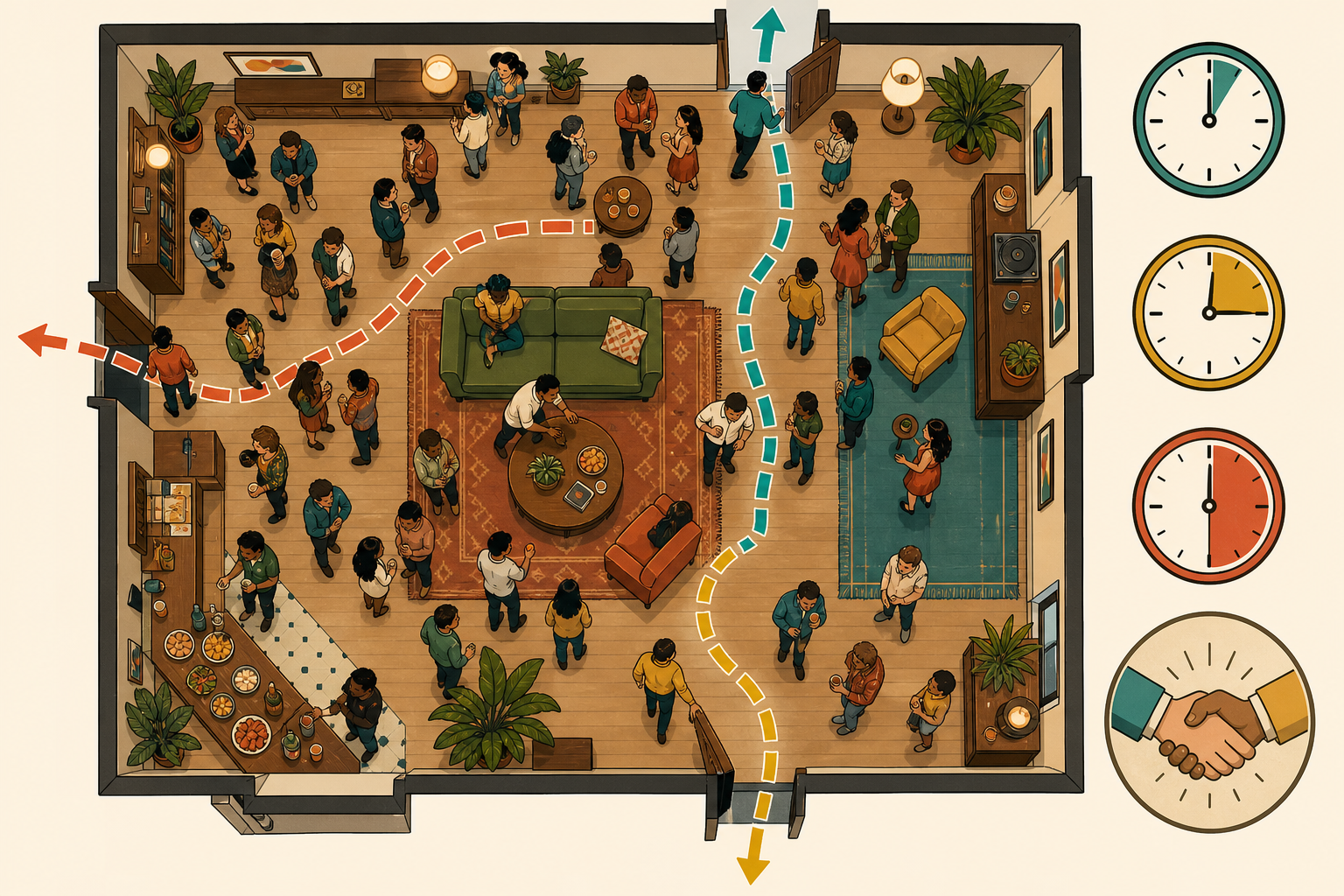
Social Survival Deep Dive
The exit: an unauthorised biography of leaving rooms, parties and conversations with zero collateral
An anatomy of departures—sighting lanes, decoy conversations, timed goodbyes and the ceremonial handshake—so you can evacuate public spaces with dignity (and an escape route mapped to your brain’s attention span).
Read article
Social Survival Deep Dive
5 funeral rites for outdated group chats you should perform with an LLM
Five theatrically different ceremonies (the Quiet Archive, the Flame Emoji Burial, the Roast & Release) with exact AI prompts and a script so you can ceremonially retire group threads nobody replies to anymore.
Read article
Social Survival Deep Dive
The Fibometer: a clear guide to what body language can — and can’t — tell you
Body language is a seductive detective: a raised eyebrow, a clipped sentence, a flash of a smile feel like evidence. This deep dive separates the usable behavioural red flags from theatrical guesswork. We cover microgestures, vocal cues, the need for baselines and clusters, and the cognitive traps that turn ordinary signals into a courtroom in your head.
Read article